
Which Murray Records Are Open
Murray records do not sit in one database. The city keeps municipal permits, GIS layers, council material, cemetery files, and police reports. Salt Lake County holds the core deed, parcel, tax, marriage, and jail trails. Utah operates the statewide court, vital-record, prison, license, and business systems. GRAMA, Utah's Government Records Access and Management Act, begins with a presumption that government records are public unless a law classifies them as private, controlled, or protected.
| Murray record group | Responsible keeper | Web access | Other access |
|---|---|---|---|
| Deeds, liens, plats | Salt Lake County Recorder | Free property list; paid Data Services detail | Counter or document request; copy fees apply |
| Property, value, tax | County Assessor, Treasurer, Auditor | Free owner, address, parcel, GIS, and tax tools | Office contact; Archives tax ledgers for history |
| District and justice cases | Utah courts and local clerks | Paid remote Xchange | Free terminals; clerk copy request |
| Birth, death, marriage, divorce | State, county health, clerk, courts, Archives | Released historical indexes vary by year | Certificate application, clerk, court, or archive |
| Jail and prison custody | County Sheriff and Utah Corrections | Free roster and offender search | Call the correct custodian |
| City and police files | Murray Recorder or Police Records | Separate city and police request routes | Email, fax, or counter where offered |
Access is not the same as full disclosure. Sealed and expunged cases, juvenile matters, adoption files, selected domestic-court filings, protected voter data, recent vital certificates, and motor-vehicle data can be closed or limited. A public docket may show that a case exists while withholding a pleading. Likewise, an online index identifies a record, but the image or certified copy may require payment or eligibility.
Murray Recorder Access Tiers
Salt Lake County Recorder Data Services holds the recorded-property trail for Murray. Its public description covers owners of record, parcel-number history, legal descriptions, recorded documents, tract indexes, chains of title, subdivision maps, and plats. The free path returns a property-linked document list. A $5 small package includes 150 data units and temporary credentials that expire when used or after 24 hours. Larger prepaid account packages begin at 10,000 units.
| Recorder entry | Input or mode | What to know |
|---|---|---|
| Property address or parcel number | Search key | Required for the public property path |
| Free Search | Access mode | Lists recorded documents linked to a property |
| Username and password | Paid login | Temporary or package account credentials |
| Small Data Package | Purchase | $5 for 150 units; 24-hour maximum life |
| Package account | Prepaid access | County setup takes one to two business days |
The county does not publish one universal online start year. Recorded images normally appear the next working day, though new plats can take longer. For copies, plain pages cost $2, historical vault pages cost $5, and certification adds $5. A request works best with book and page or the abstract/index citation, party names, dates, and document type. The county contacts the requester when an order is ready.
The Recorder Data Services landing screen shows the account and property-record options.
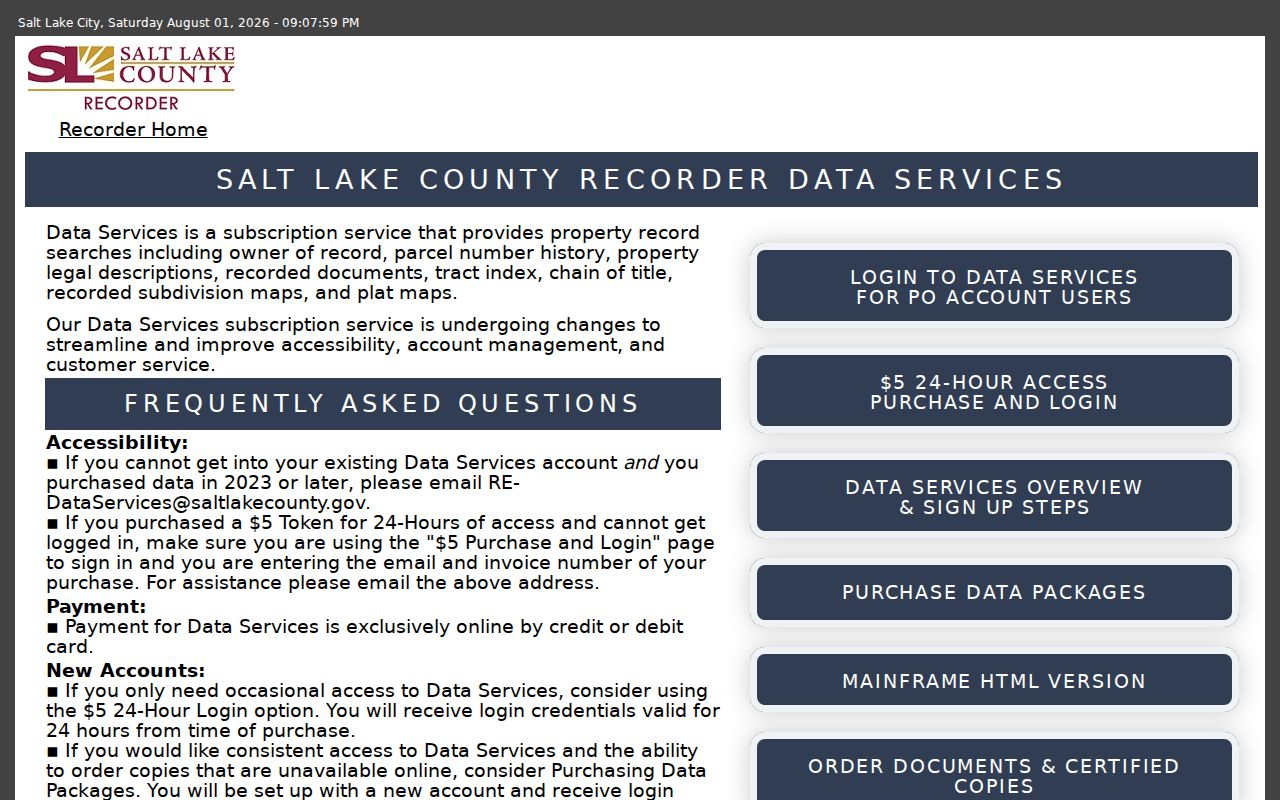
The screen helps distinguish the free document list from paid access to deeper recorded-property data.
Murray Parcel Records Start Free
The Recorder's public route is keyed to a property, not an open-ended person search. Start with the Salt Lake County Assessor instead. Its owner field accepts at least the first three letters and uses the form LAST, FIRST for a person. An address can use street number, direction, street name, and type. A parcel search accepts the first ten digits, with four optional encumbrance digits, while the first seven digits can return a block.
Keep the full 14-digit parcel identifier. It links the assessor entry, county GIS, Recorder Data Services, Treasurer material, and historical work. The map also accepts an address or full parcel ID and can query owner, property type, or tax district. Its parcel panel, layers, imagery, print tools, and export controls add location context, but a mapped boundary is not a deed. A deed relies on the legal description and recorded instrument.
The Salt Lake County Interactive Parcel Map provides the spatial part of this Murray records trail.
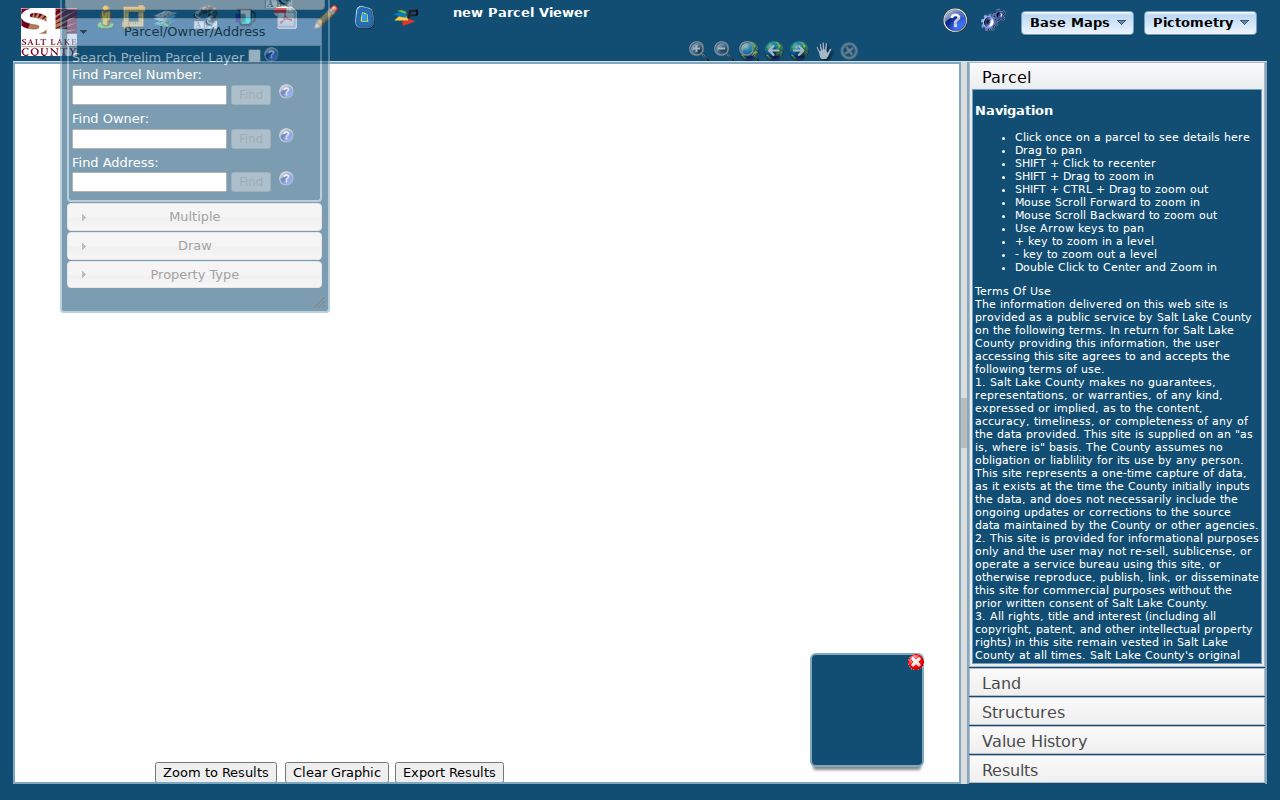
Use the mapped parcel ID to connect a current location with the Recorder's document history and the Archives' older tax ledgers.
Note: A situs address is the property's location; a mailing address is the tax-notice destination and may belong somewhere else.
Murray Court Records by Channel
Murray Justice Court handles city ordinance matters, Class B and C misdemeanors, infractions, traffic, and small claims. Third District Court handles general civil, domestic, probate, felony, and Class A misdemeanor matters. Probate belongs with the district court, not the County Clerk. Utah Courts Xchange searches statewide public district and justice data by jurisdiction, case number, party name, case type, court scope, birth date where available, citation number, and several date ranges.
Remote access has a price. A guest account costs $10, searches cost $0.20, and eligible documents cost $1. Subscription terms differ. Occasional users can use the free CORIS terminal route at most district courthouses or the Utah State Law Library. Call before relying on a justice-court terminal. Clerk copies are another channel when a complete file or certification is needed, and the Utah Archives civil-court guide identifies older transferred material.
The Utah Courts Xchange field guide explains results with court location, case type, number, filing date, parties, and history links. The separate CORIS coverage table supplies court-specific conversion dates. Extended histories may include events, documents, hearings, judgments, outcomes, and criminal charges. Sealed, expunged, adoption, civil-commitment, juvenile, and protected family matters do not appear in full.
Murray Vital Records Release Clocks
Utah does not open every vital record on the same schedule. Under Utah Code §26B-8-125, a birth becomes public 100 years after the birth date, a death after 50 years, and marriage or divorce vital material after 75 years. Before those points, a requester needs a direct, tangible, and legitimate interest. The subject, immediate family, guardian, or designated legal representative may qualify with identity and relationship proof.
The Utah vital certificate service covers recent birth and death records plus short-form marriage and divorce certificates for 1978 through 2010, with limited later marriage coverage. The Salt Lake County Clerk is the marriage-license route outside that state abstract span. A divorce decree or case file comes from district court. The Utah Archives marriage guide directs pre-1940 Salt Lake County material toward County Archives.
- Index
- A finding list that identifies a record but may not show the underlying image.
- Certified copy
- An official copy authenticated by the office that holds the record.
- Custodian
- The government office responsible for retaining and answering for a record.
- Exemption
- A law-based reason that all or part of a record is not released.
Historical access moves each year as another birth or death year reaches its release point. That rolling line is why a once-closed family record may later appear in an Archives index without any change to its contents.
Murray Custodians and Public Records
The right office depends on the event, not just the Murray address. Salt Lake County's main land and tax offices sit in Salt Lake City because Murray is not the county seat. City administrative files remain with Murray. Court case copies go to the court clerk, while licenses and election material run through the County Clerk. Counter, phone, and written-request channels remain useful when a portal is gated or has no historical start date.
Salt Lake County Recorder
2001 S State St N1-600
Salt Lake City, UT
385-468-8145
Police reports take a separate route from ordinary city records. Murray Police accepts its form in person, by fax at 801-264-2568, or by email at policeadmin@murray.utah.gov. The department states that processing may take ten business days. Identification, hand delivery, or a waiver can be needed for some cases.
Murray Jail and Offender Records
Custody records also split by agency. The Salt Lake County Sheriff roster covers county jail custody and current docket information. It is not a complete history of everyone booked and released that day, and staff do not provide release dates. Utah Department of Corrections searches current prison, probation, or parole status by a person's first and last name or by UDC ID. It does not replace the county roster for unsentenced or pretrial custody.
The Salt Lake County jail docket and roster page is the county-level starting point.
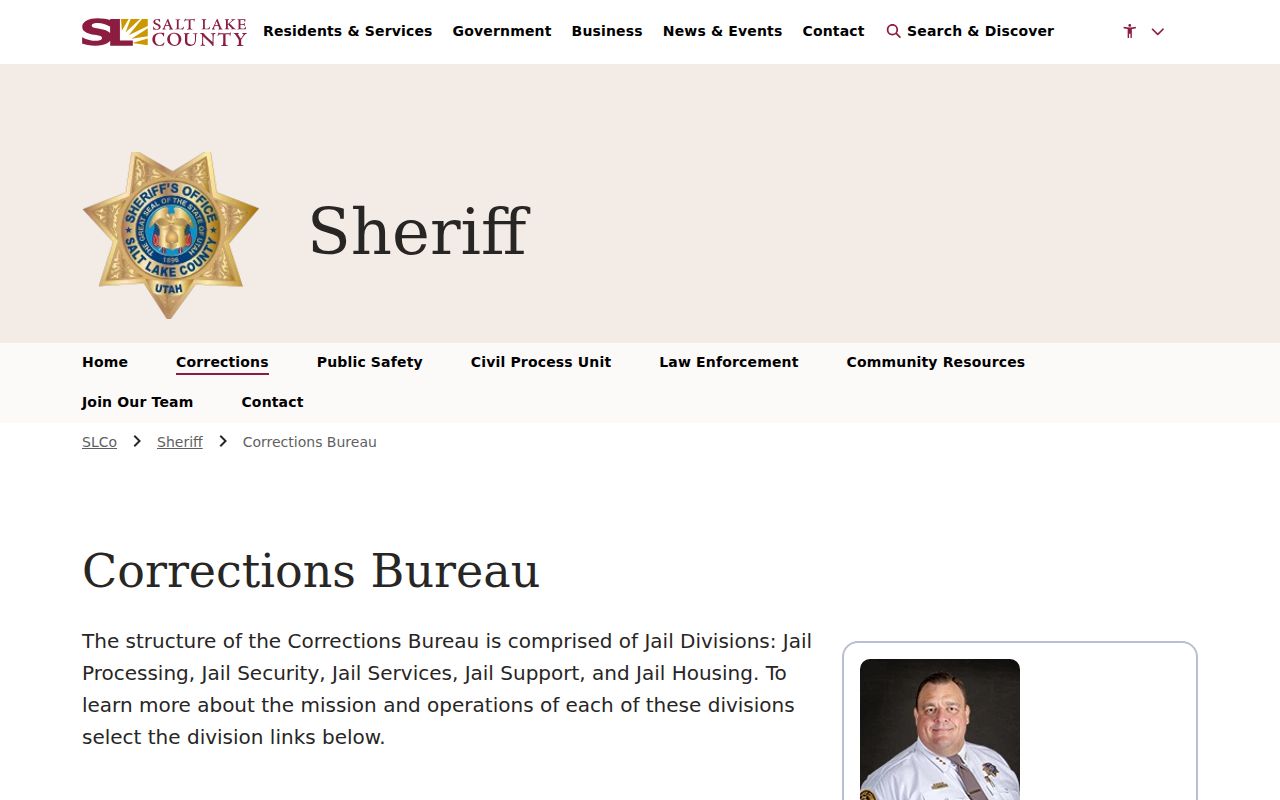
Its point-in-time custody scope should be checked against the court docket when the legal case status also matters.
The Utah offender search provides the separate state-custody channel.
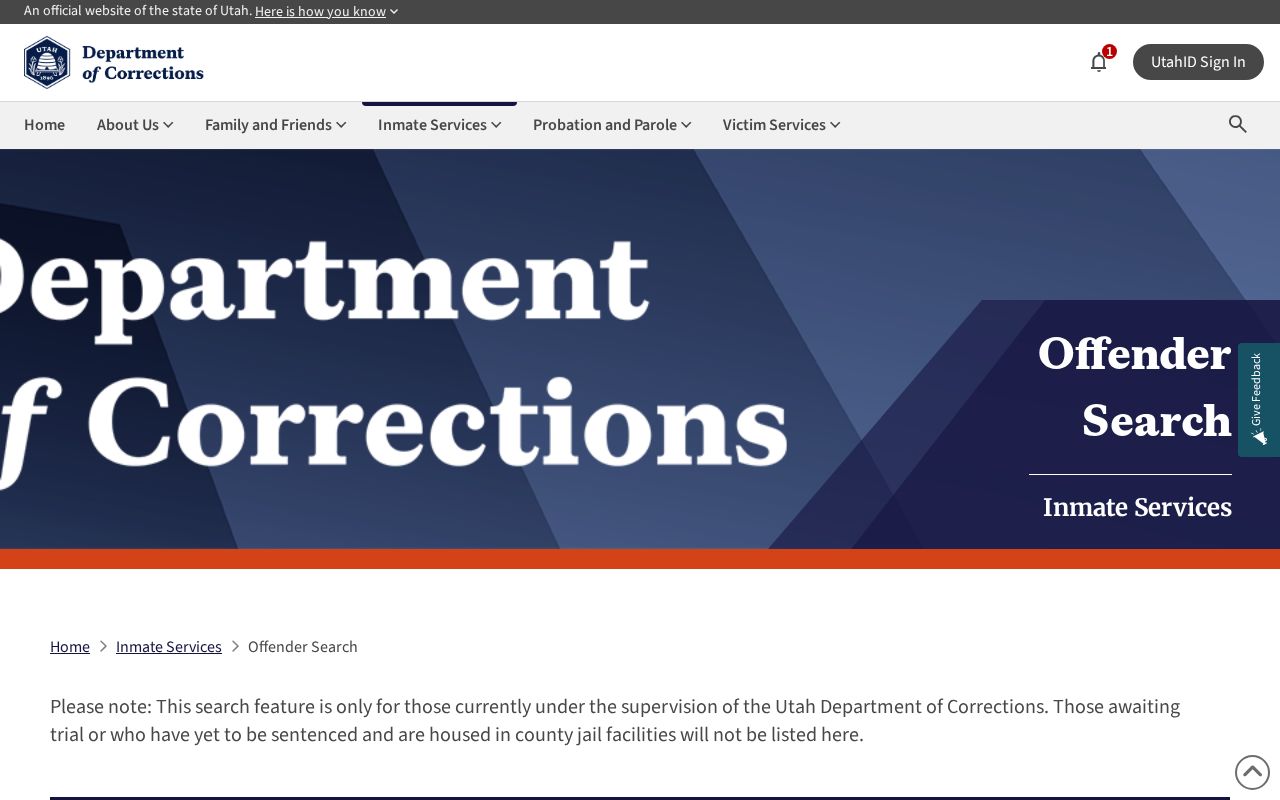
Using both official systems prevents a county jail stay from being mistaken for state prison or supervision status.
Registry data has its own limits. Utah's public sex and kidnap registry warns that information can be incomplete and must not be used for harassment. Some identifying details are collected for administration but are not necessarily displayed to the public.
Murray Legacy Records in Transition
Murray is moving old government data across systems. The FY2025/26 budget funds the move of remaining AS/400 data into RVI and an interface for historical material. The city is also shifting Munis toward cloud access. Preserve an old identifier when asking for a file. New permits use an E-prefix, while legacy permit numbers have seven digits. Giving staff both the address and known file number can help them search across the cutover.
Geography can change the keeper too. The Van Winkle annexation became effective July 1, 2025. For an older municipal event in that area, state the event date and ask whether records transferred from the prior jurisdiction. Deeds and county taxes remain county records even when a boundary changes. This distinction keeps a city request from being sent to the wrong office.
Murray's city record trail starts with incorporation in 1903, while Salt Lake County land and probate custody reaches farther back. A nineteenth-century deed should not be requested from the Murray City Recorder. For older parcel history, use county recorder records, tax ledgers, archives, and other period sources.
Note: A platform change marks an access cutover, not proof that the underlying Murray record series began or ended that year.
Filing Murray Public Records Requests
GRAMA requests must go to the entity that keeps the record. Utah Code §63G-2-204 calls for the requester's name, mailing address, daytime phone, email if the requester accepts email, and a reasonably specific description. Murray's ordinary city form covers existing material such as permits, occupancy certificates, hazardous-material records, and GIS shapefiles. Police and fire records are excluded from that route.
- Name the keeper. Decide whether Murray City, Murray Police, Salt Lake County, a court, or a state office retains the file.
- Check current access. Use the official index or public terminal when it can identify the exact parcel, case, document, or date.
- Describe an existing record. Give names, address, parcel or case number, record series, department, and a tight date range. State the desired electronic format and whether certification is needed.
- Address cost early. Ask for an estimate before costly compilation, state any fee-waiver basis, and be ready for lawful prepayment.
- Read the response. The agency may produce the file, deny it with a legal reason, report that no record exists, or give an estimate under extraordinary circumstances.
The normal maximum is ten business days. A demonstrated public-benefit request can qualify for a five-business-day route. GRAMA allows reasonable actual production costs, with the first 15 minutes of staff time ordinarily free subject to repeat-request rules. A waiver may be available when release chiefly benefits the public or when the requester is the subject or an authorized recipient.
The Murray City GRAMA form shows the fields, delivery choices, and fee-waiver option used for ordinary city files.
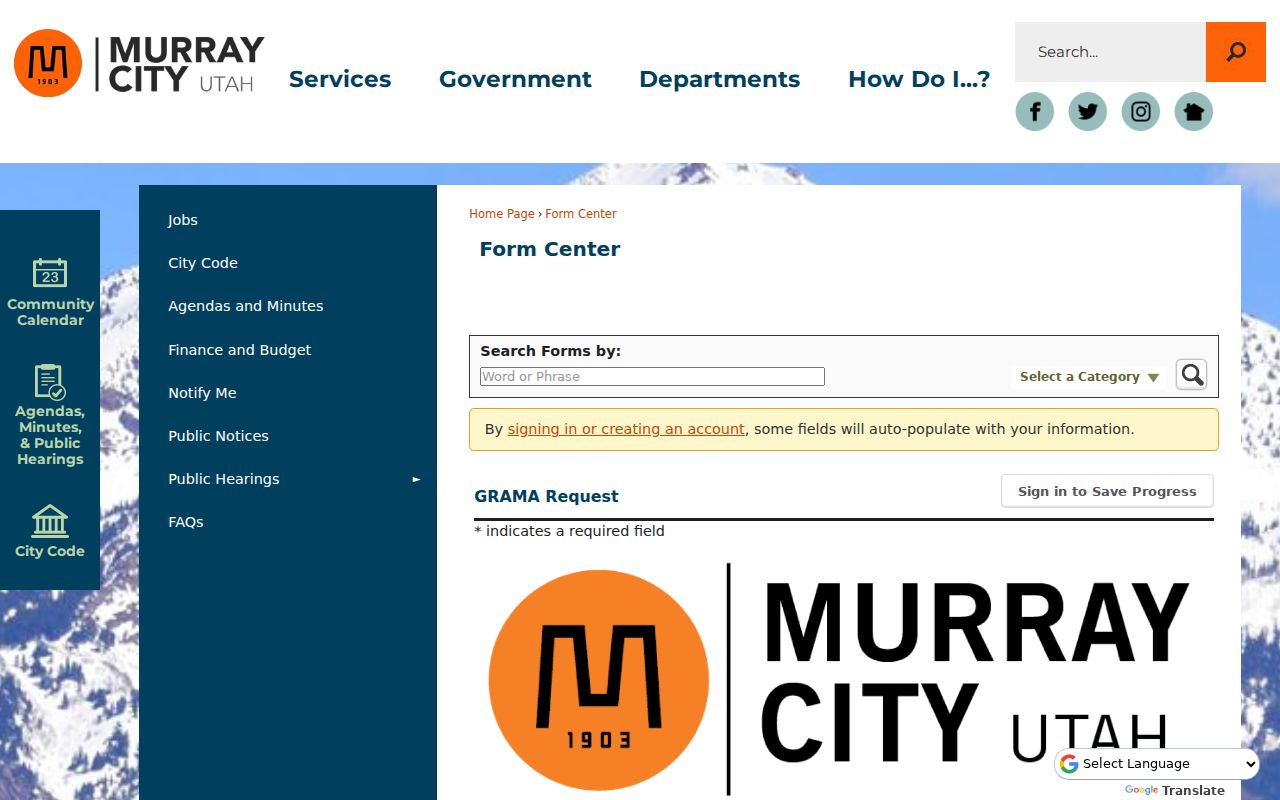
The form's department, date-range, and record-description fields reward a narrow request that staff can tie to a real file.
Lawful use. Open records support family research, estate work, consumer safety, and civic review. Never use a record to stalk, harass, threaten, or evade a protected address.
Appealing a Utah Records Denial
A denial should identify the record's classification or exemption and explain the appeal route. Start with the agency's chief administrative officer. Following Utah's 2025 structural change, further administrative review runs through the Director of the Government Records Office, which replaced the State Records Committee. District-court review remains available where GRAMA permits it, and the Government Records Ombudsman can help requesters and agencies understand the process.
The Utah Government Records Office publishes the current administrative-review route. A narrow appeal should address the cited classification, identify any segregable public portion, and keep the original request and response dates. If the problem is breadth or cost rather than legal closure, refining the date range, department, file type, or identifier can be faster than contesting every part of the response.
Silence after the legal response period is treated as a denial. Extraordinary circumstances are different: the agency must identify the circumstance and estimate when the record will be available. That written distinction helps determine whether to wait, narrow the request, or use the formal appeal path.